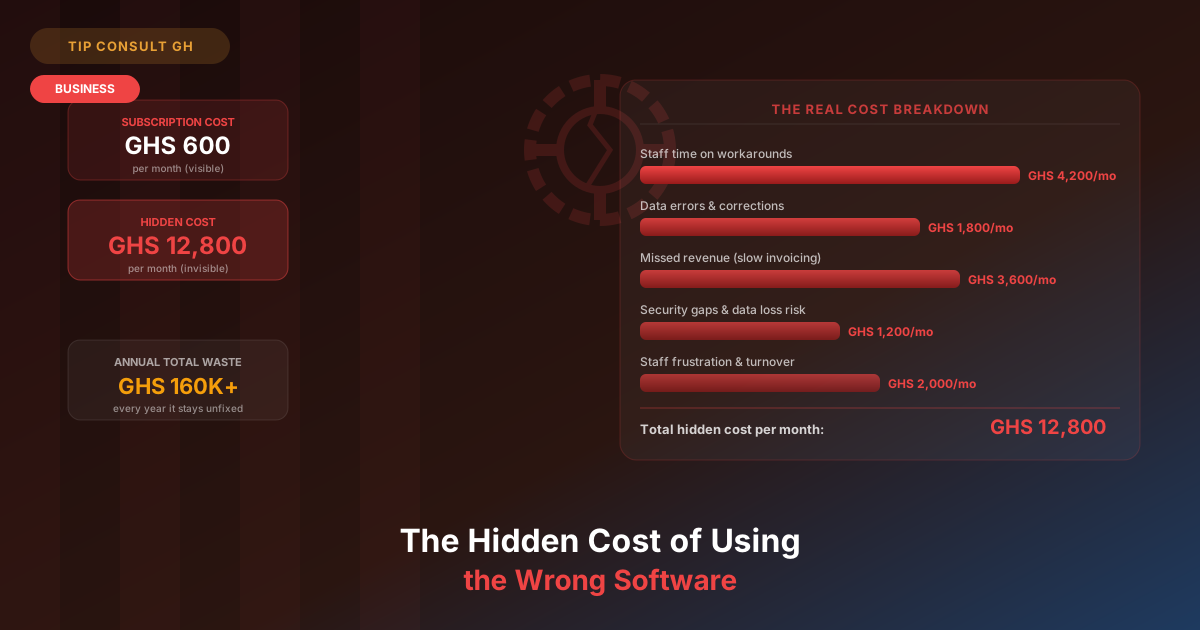
Most business owners think about software cost in terms of what they pay for a licence or subscription. Very few think about the cost of what the software fails to do — the hours lost to workarounds, the invoices delayed, the data errors that multiply, and the security vulnerabilities left open. The wrong software does not just cost money directly. It drains your business slowly, in ways that rarely show up on a single line of a financial report.
A Story From Accra's Trading Sector
Consider Kwame's wholesale trading company, based in Accra and serving retailers across three regions. When Kwame started, he used a popular accounting software package that a friend recommended. It worked adequately in the early days. But as the business grew to 200 product lines, eight staff, and customers spread from Kumasi to Takoradi, the cracks began to show.
His sales team kept a separate spreadsheet for orders because the software's order entry interface was too slow. His accountant maintained a third spreadsheet to reconcile mobile money payments, because the system was not built for Ghana's payment landscape. His warehouse manager kept a fourth list because the stock reports were never accurate. By the time an invoice reached a customer, it had often passed through three different people doing manual reconciliation work.
Kwame was not paying for bad software. He was paying for good software that was simply wrong for his business. And the cost — in staff time, in errors, in delayed payments, in customer frustration — was far higher than any licence fee.
The Cost of Staff Time on Workarounds
When software does not fit your processes, your staff create workarounds. They copy data from one system to another. They maintain parallel spreadsheets. They do manual calculations that should be automated. They re-enter the same data in multiple places.
This time has a cost. A staff member who spends two hours per day on manual workarounds is spending roughly 500 hours per year on tasks that should take minutes. At any reasonable hourly rate, that is a significant hidden expense — before you factor in the errors that inevitably creep in when humans transfer data manually.
The insidious thing about workaround costs is that they normalise. After a few months, nobody questions why the process works this way. It becomes "just how things are done here." The cost becomes invisible because it is built into the baseline of operations.
Data Errors and the Decisions They Poison
Bad data is arguably the most dangerous consequence of wrong software. When your customer records are inconsistent, your sales data is unreliable, or your stock counts are off, every business decision you make is being informed by bad intelligence.
You might be reordering products that are not actually selling well, while running short on your best-sellers. You might be extending credit to customers who are already significantly overdue. You might be reporting profits that look healthy, while your actual cash position tells a different story. Data errors compound. A small inaccuracy in January can snowball into a significant discrepancy by December.
Slow Invoicing and Missed Revenue
Cash flow is the lifeblood of any business, and invoicing speed is directly tied to cash flow. If your software makes invoicing cumbersome — requiring multiple steps, manual entry, or separate payment tracking — invoices get delayed. Delayed invoices mean delayed payment. Delayed payment means cash flow pressure that forces you to borrow, delay supplier payments, or miss growth opportunities.
In Ghana's business environment, where many transactions are still relationship-based, a customer who does not receive a timely invoice may simply assume the debt has been forgotten. A business that invoices immediately is a business that gets paid faster. Software that makes invoicing easy is software that improves your cash position every single month.
Security Gaps That You Cannot See
Older software, unsupported software, or software that was never designed for your type of business often carries security vulnerabilities that are not obvious until something goes wrong. Customer data may not be encrypted. Access controls may be weak, meaning any employee can see any customer's financial information. Backups may not be happening reliably. The software may not be receiving security updates.
In Ghana's business environment, where mobile money fraud and data theft are growing concerns, a security breach can be catastrophic. The reputational damage of losing customer data, combined with any regulatory consequences, can outweigh years of operational savings from using cheap or legacy software.
The Switching Cost Trap
One reason businesses stay with the wrong software longer than they should is the fear of switching. Migrating data, retraining staff, and enduring a period of reduced productivity while teams adapt — these are real costs. But they are one-time costs. The cost of staying with the wrong software is ongoing. Every month you delay the switch, you accumulate more workaround hours, more data errors, more delayed invoices, and more security risk.
The switching cost trap is particularly powerful because the pain of the current situation is distributed across many small moments throughout the working day, while the cost of switching feels like a large, immediate, concentrated event. Humans consistently underestimate ongoing small costs and overestimate large upfront costs. The right calculation is to add up twelve months of workaround costs and compare that to the one-time switching investment.
Warning Signs That Your Software Is Costing You
Here is a checklist of red flags that indicate your current software may be doing your business more harm than good:
- Your staff maintain spreadsheets to supplement the software's records
- It takes more than 24 hours to produce an invoice after a sale
- You cannot get a reliable view of your current stock levels at any moment
- Your software does not support mobile money payment recording natively
- Staff use personal email or WhatsApp to transfer business data because the software does not support collaboration
- You cannot run a report showing which customers owe you money without manual reconciliation
- Multiple staff members share the same login credentials
- Your software has not received an update in more than a year
- You have experienced unexplained discrepancies between your software records and your bank statements
- New staff take more than a week to learn how to use the software for basic tasks
If three or more of these apply to your business, the cost of your wrong software is almost certainly higher than the cost of replacing it.
What to Do About It
The first step is an honest assessment. Document the workarounds your team uses. Estimate the hours spent on them per week. Calculate what those hours cost. Add in the revenue impact of delayed invoicing and the risk profile of your current security posture. This gives you a realistic picture of what the status quo is actually costing you.
The second step is to define what the right software looks like — not in terms of features, but in terms of how your business actually works. What are your actual processes? What does your team need to do every day? What reports do you need to make decisions? A technology partner who takes time to understand your business before recommending a solution is worth far more than one who sells you a product from a catalogue.
At Tip Consult GH, we build custom software that is designed around how Ghanaian businesses actually operate — including mobile money integration, offline capability for areas with unreliable internet, and reporting that reflects Ghana's regulatory requirements. If your current software is costing you more than it should, let us have a conversation about what the right solution could look like for you.