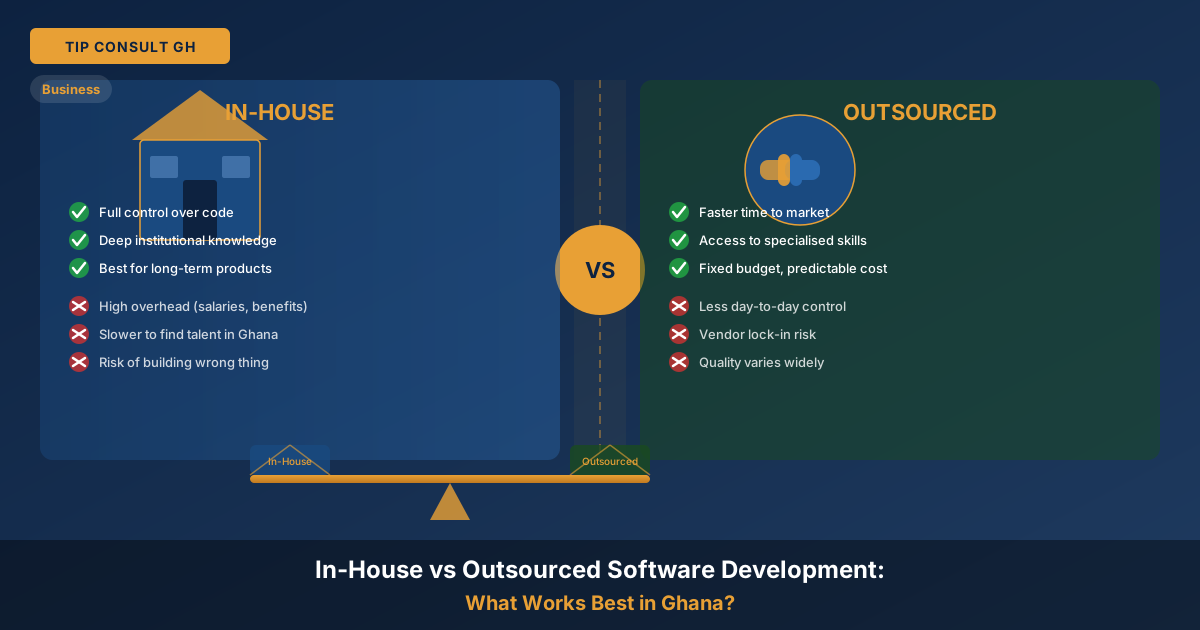
Every growing business in Ghana eventually reaches the same fork in the road: we need software, so do we hire developers or do we bring in an external firm? It is one of the most consequential technology decisions a business can make — and it is almost always made with incomplete information. This article gives you the full picture.
First, Be Clear on What You're Actually Deciding
The in-house vs. outsource question is really three separate questions bundled together:
- Who owns the knowledge? In-house teams build institutional knowledge. Outsourced teams deliver a product and leave.
- Who controls the timeline? In-house gives you direct control; outsourcing means you're one client among many.
- Who carries the cost risk? In-house costs are fixed and ongoing; outsourced costs are variable per project, but can escalate sharply if scope isn't locked.
Understanding what you're actually trading off helps you make the decision based on your specific situation rather than general advice.
When In-House Works
Building an in-house development team makes sense when several conditions are true simultaneously:
- Software is your core product. If your business revenue depends directly on software you continuously improve, you need developers who understand your domain deeply and are fully committed to your roadmap. A fintech building its loan engine, or an EdTech building its learning platform, cannot afford the knowledge loss that comes with rotating external teams.
- You have long-term, continuous development needs. In-house makes economic sense when you need ongoing development — not one-time builds. If you're shipping weekly features, fixing bugs daily, and maintaining infrastructure, a permanent team costs less per output than a series of outsourced engagements.
- You can attract and retain talent. This is the hard part in Ghana's market. Experienced developers are in high demand and command salaries that SMEs often can't match. If you can't compete on pay, career growth, or culture — you won't retain the team you build.
- You have management capacity. Running a development team requires technical leadership. Without a senior developer or CTO to set standards, review code, and manage the team, an in-house setup produces inconsistent, unmaintainable software.
In short: in-house is for organisations that are mature enough, funded enough, and committed enough to make it work long-term.
When Outsourcing Wins
Outsourcing is the right choice far more often than many business owners admit. It makes sense when:
- You are in the startup or early-growth phase. Your requirements will change. Your product vision will evolve. Hiring full-time developers before you've validated what you need to build is an expensive mistake. A good outsourced partner can build your MVP, adapt as you learn, and hand over documentation when you're ready to bring development in-house.
- You need specialised skills for a defined scope. Mobile app development, ERP integrations, AI/ML features, payment gateway implementations — these require deep expertise that most businesses only need occasionally. Outsourcing gives you access to specialised skills without the cost of permanent employment.
- You have a fixed budget and defined outcome. A well-scoped, fixed-price outsourced project is predictable in a way that in-house development rarely is. If you know exactly what you need built and by when, outsourcing can deliver it more cost-effectively.
- Speed-to-market matters more than long-term ownership. An experienced outsourced team can move faster in the short term because they've built similar things before. They bring patterns, libraries, and hard-won knowledge that an in-house team building for the first time won't have.
"The best argument for outsourcing is not cost — it's access to expertise you couldn't afford to hire full time, exactly when you need it."
The Hybrid Model: Best of Both Worlds
Increasingly, smart Ghanaian businesses are adopting a hybrid approach that captures the advantages of both models:
- A small in-house team — one senior developer or technical lead, possibly a product manager — who owns the product vision, manages vendor relationships, and maintains institutional knowledge.
- Outsourced execution for specific builds, features, or periods of high demand — bringing in external capacity without permanent headcount.
This model works well because the in-house lead provides continuity and quality control, while the outsourced team provides capacity and specialisation. The risk — which is real — is that the in-house technical lead becomes a single point of failure. Mitigate this with good documentation standards from the start.
Red Flags in Outsourcing Partners
If you do outsource, avoid partners who exhibit these warning signs:
- They agree to everything in the sales call. A competent partner pushes back on unrealistic timelines or requirements that conflict. Unlimited agreement is a sign they'll tell you what you want to hear and deliver something different.
- No discovery phase before quoting. Any firm that gives you a fixed price without first understanding your requirements in depth is guessing. That guess will be wrong, and you'll pay for it in change orders.
- They can't show you previous work. Ask for live URLs or references from past clients. Portfolios with screenshots are not enough — software that looks good doesn't necessarily work reliably.
- No clear ownership of code and IP in the contract. Your software is your asset. The contract must explicitly state that you own all code, databases, and intellectual property. If the partner resists this clause, walk away.
- No documentation of what they deliver. Code without documentation is a liability, not an asset. Ask explicitly: will we receive technical documentation, API specs, deployment guides, and admin credentials upon project handover?
- They communicate poorly or inconsistently. How a firm communicates during sales is how they'll communicate during a crisis. If responses are slow, vague, or evasive before you've signed a contract, they won't improve after.
8-Point Checklist: What to Look for in an Outsourcing Partner
Use this checklist when evaluating firms:
- Relevant domain experience. Have they built similar software for your industry? Domain knowledge accelerates delivery and reduces requirement gaps.
- Local understanding. Do they understand Ghanaian business context — local payment rails, regulatory requirements, user behaviour? Or are they applying foreign patterns to local problems?
- Clear discovery process. Do they conduct a structured requirements gathering phase before scoping and pricing?
- Transparent project management. How will you track progress? Do they use a project management tool you have visibility into?
- Testing standards. Do they write tests? How do they handle bugs found in production? What is their quality assurance process?
- Post-launch support terms. What happens after delivery? Is there a warranty period? What are maintenance and support costs?
- IP and data ownership in writing. All code, databases, and credentials belong to you. This must be stated explicitly in the contract.
- References you can actually contact. Ask for two or three previous clients and call them. Ask specifically: did the project deliver on time, within budget, and does the software still work reliably today?
The Honest Conclusion
There is no universally correct answer to the in-house vs. outsource question. The correct answer depends on your business stage, your budget, your product's strategic importance, and your capacity to manage a technical team or vendor relationship.
What we can say with confidence: both approaches fail when they are chosen by default rather than by design. Outsourcing fails when businesses treat it as a shortcut — choosing the cheapest quote, skipping the discovery phase, and expecting a polished product from an incomplete brief. In-house fails when businesses hire developers without the technical leadership to direct them.
If you are trying to make this decision and want an honest assessment of which approach fits your specific situation, we are happy to have that conversation — with no obligation and no sales pitch at the end.
Let's Talk About Your Software Strategy