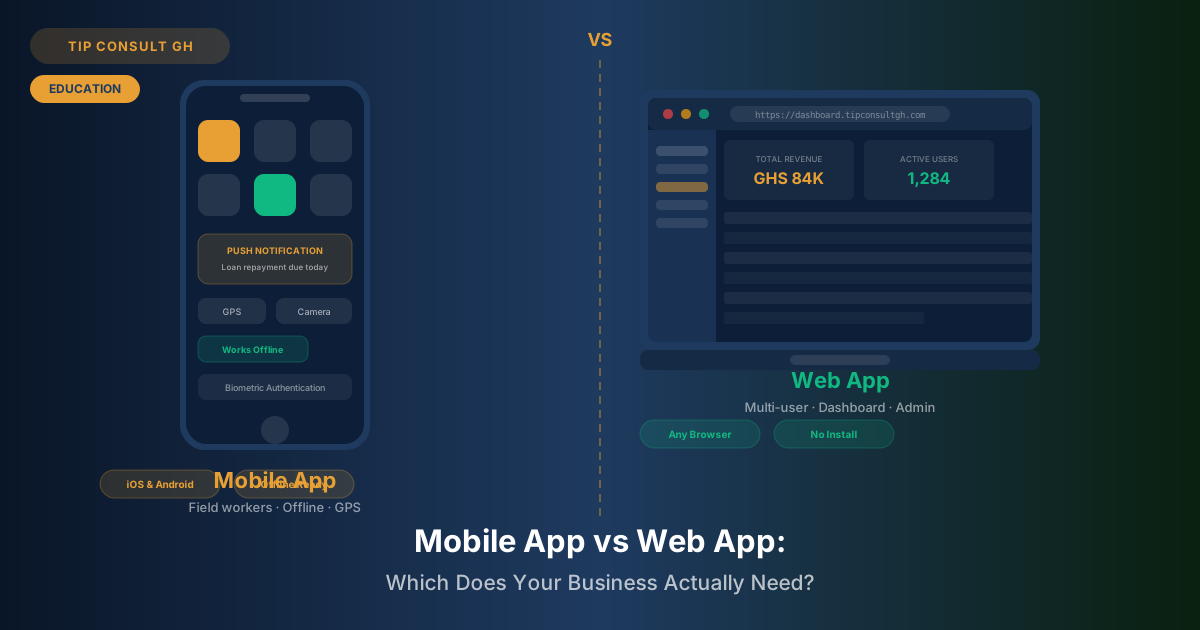
"Should we build a mobile app or a website?" is the most common question we hear from business owners starting their digital journey. The answer is not always obvious — and getting it wrong means spending money on something that does not fit how your customers and team actually work.
First: What Is the Actual Difference?
A web application runs inside a browser. Your users open Chrome, Safari, or Firefox, navigate to your URL, and access the system. No installation required. It works on any device — desktop, tablet, or phone — as long as there is a browser and internet access.
A mobile application is installed on a smartphone or tablet — either from the Google Play Store (Android) or the Apple App Store (iOS). It can access device hardware directly: camera, GPS, accelerometer, Bluetooth, and fingerprint scanner. It can also store data locally and work without internet.
There is also a third option — a Progressive Web App (PWA) — which is a web app that behaves like a mobile app: it can be added to the home screen, works offline, and sends push notifications. This is often the smartest starting point for businesses with limited budgets.
When You Need a Mobile App
Choose a native mobile app when your use case genuinely requires it:
- Field workers without reliable internet — loan officers collecting repayments in rural communities, delivery drivers, field inspectors. Mobile apps can store and sync data offline.
- Camera access is core to the workflow — capturing Ghana Card photos for KYC, documenting collateral, scanning QR codes at point of sale.
- GPS tracking is essential — field staff location, delivery tracking, geo-fenced attendance.
- Biometric authentication — fingerprint login for security-sensitive apps like banking or HR systems.
- Push notifications drive your model — payment reminders, order updates, appointment alerts sent directly to the lock screen.
When a Web App Is the Right Choice
Web apps win in most back-office, admin, and multi-user scenarios:
- Dashboard-heavy systems — management reporting, analytics, financial dashboards. These need screen space and are naturally desktop-first.
- Multi-user workflows — CRM systems, project management tools, ERP platforms used by teams across multiple branches.
- No app store friction — staff and customers can access the system immediately with a link. No installation, no app store approval delays, no "please update your app" issues.
- Frequent updates — web apps update instantly on the server. Mobile apps require users to download updates, and outdated versions can cause data inconsistencies.
- Cross-device access from day one — your accountant works on a laptop, your manager checks on a tablet, your customer queries on a phone. A responsive web app covers all three.
The Cost Reality
A native mobile app for both iOS and Android typically costs 2–3× more than an equivalent web app — because you are building and maintaining two separate codebases (or one cross-platform codebase that still requires platform-specific work). Factor in annual developer account fees, app store review delays, and the need to push updates to user devices.
For most Ghanaian businesses starting their digital journey, we recommend beginning with a well-built, mobile-responsive web app. Once it is live and generating data, you can identify which specific features genuinely need a native mobile experience and build that layer second.
Quick Decision Checklist
- Do your users work offline regularly? → Mobile app
- Does your workflow require camera or GPS? → Mobile app
- Is your system admin-heavy or dashboard-focused? → Web app
- Do you need to launch fast and iterate? → Web app first
- Do you need both field and office access? → Web app + PWA, or both
- Is your budget limited? → Start with web, expand later
What Tip Consult GH Recommends
We build both — and we help our clients make the right choice for their situation before a single line of code is written. Our discovery process identifies your users' actual workflows, connectivity constraints, and device preferences before we recommend a platform.
Ready to figure out the right approach for your business? Book a free consultation with our team.