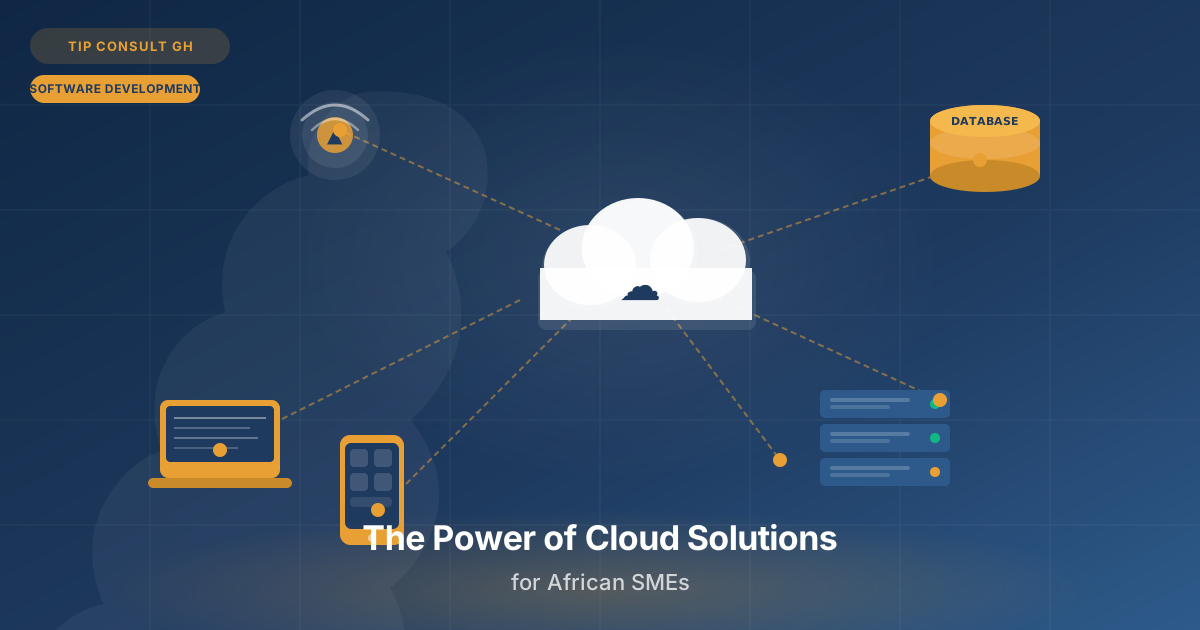
For decades, enterprise-grade technology was the exclusive preserve of large corporations. Cloud computing has changed that permanently. Today, a two-person business in Kumasi can run on the same infrastructure as a Fortune 500 company — and it costs a fraction of what it used to.
What Cloud Solutions Actually Mean for SMEs
Cloud computing means your applications and data live on servers managed by a provider — Google, Amazon, Microsoft, or a regional provider — rather than on a physical machine in your office. The practical implications for an African SME are significant:
- No upfront hardware cost — no servers to buy, configure, or maintain
- Access from anywhere — your team can work from a phone, a branch office, or from home
- Automatic backups — data is replicated across multiple locations, so a power surge or theft doesn't mean data loss
- Scale on demand — pay for what you use; scale up when business grows, scale down when it's quiet
- Enterprise security — your data is protected by the same security infrastructure trusted by banks and governments
Africa-Specific Advantages
Cloud solutions solve problems that are uniquely acute in the African context:
Unreliable power
When the lights go out, a local server goes down — and so does your business. A cloud-hosted application keeps running regardless of what happens to your local power supply.
Mobile-first workforce
Much of Africa's workforce accesses the internet primarily through smartphones. Cloud applications that are designed mobile-first reach your staff and customers where they actually are — not where a desktop-era developer imagined they would be.
Multi-location businesses
Managing two or more offices used to require expensive dedicated lines or clunky VPN setups. A cloud-based system means all your branches share one live data source, with no synchronisation lag or IT headaches.
Common Misconceptions
"Isn't cloud storage just someone else's computer? Is my data safe?"
This is the most common concern we hear. The answer: yes, cloud infrastructure runs on hardware owned by the provider. But "safe" is relative. Your data on a cloud platform with enterprise-grade encryption, multi-region replication, and automated backups is far safer than data on a local server in an office that could flood, be burgled, or suffer a hard drive failure.
The key is choosing a reputable provider and ensuring your application is built with proper access controls, encryption at rest and in transit, and audit logs. That's exactly what we build at Tip Consult GH.
Getting Started: A Practical Roadmap
Moving to the cloud does not need to be an overnight revolution. A pragmatic migration might look like this:
- Audit your current tools — identify which systems are critical, which are redundant, and which are already partially cloud-based
- Start with a single workflow — migrate one high-value process (e.g., invoicing or inventory) to a cloud system first
- Train your team — the best technology fails if people don't adopt it. Budget time for training
- Measure and expand — after 90 days, measure the impact and use that data to justify the next migration
How Tip Consult GH Can Help
We design and build cloud-native applications — from CRM and ERP systems to industry-specific platforms like CreditPak (for microfinance) and SchoolPak (for schools). Every product we build leverages cloud infrastructure for reliability, scalability, and security.
Whether you want to migrate an existing system or build a new cloud-first application, get in touch for a free consultation.