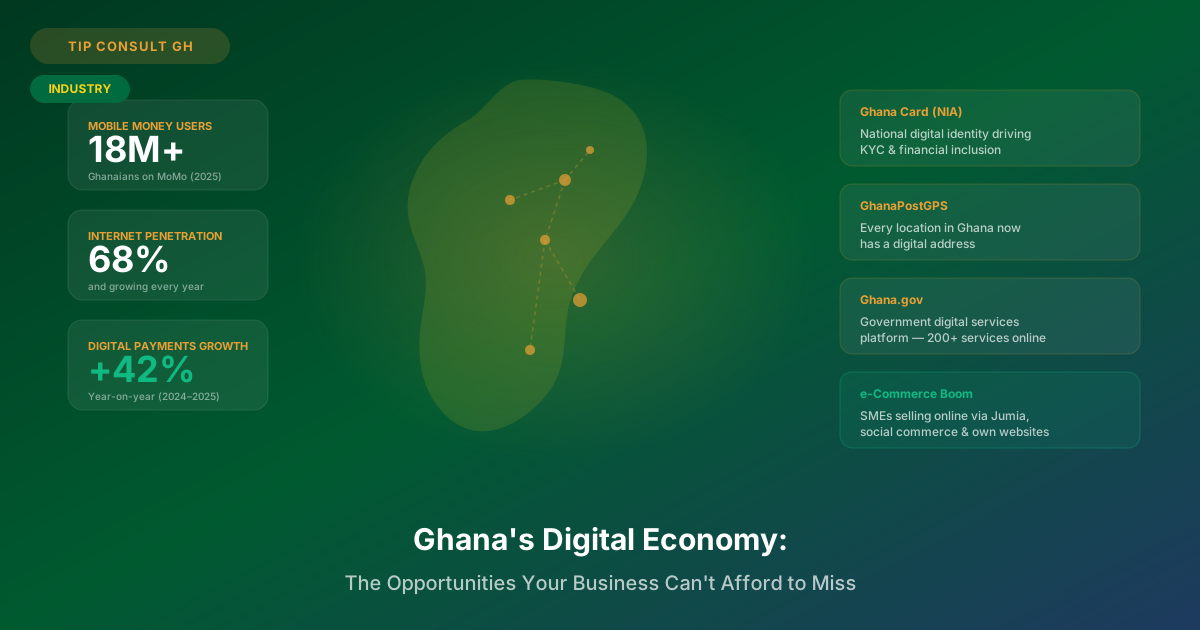
Ghana is not waiting for the digital revolution to arrive. It is already here. With over 18 million active mobile money users, a national digital addressing system, biometric identity infrastructure, and a government that has committed to digitalising its own services, the opportunity landscape for Ghanaian businesses has never been richer. The question is not whether your business should go digital — it is how fast you can move before your competitors do.
Mobile Money: The Infrastructure That Changes Everything
Ghana's mobile money ecosystem is one of the most advanced on the African continent. MTN MoMo, Vodafone Cash, and AirtelTigo Money collectively serve more than 18 million registered users, and transaction volumes continue to climb year after year. This is not just a convenience story — it is an infrastructure story.
For businesses, mobile money means you can collect payments from customers in Tamale, Bolgatanga, or Sunyani without a physical point-of-sale terminal or a bank branch nearby. It means payroll can reach field staff instantly. It means school fees, loan repayments, and service subscriptions can be automated. Any business that has not yet integrated mobile money into its payment flows is leaving money on the table — sometimes literally.
The maturity of Ghana's interoperability framework, where payments can move seamlessly between networks and into bank accounts, makes this even more compelling. The rails exist. You just need to build on them.
GhanaPostGPS: Digital Addresses Are Now Real
For years, delivery logistics in Ghana was a game of landmarks and phone calls. "Pass the big mango tree and turn left at the blue building." GhanaPostGPS has changed this. Every location in Ghana now has a unique digital address, and that address can be captured in a mobile app, stored in a database, and used to route deliveries accurately.
For e-commerce businesses, this is transformational. Last-mile delivery was the biggest barrier to growing an online store beyond Accra. With GhanaPostGPS integration, platforms can now validate delivery addresses, calculate accurate shipping costs, and track deliveries with confidence. If your business ships physical goods, integrating GhanaPostGPS into your ordering system is no longer optional — it is a competitive necessity.
NIA Ghana Card: The KYC Revolution
The National Identification Authority's Ghana Card has quietly become one of the most powerful digital tools available to Ghanaian businesses. With biometric verification capabilities and a unique national ID number for every citizen, the Ghana Card enables Know Your Customer (KYC) processes that used to take days to complete in minutes.
Financial institutions, microfinance companies, insurance providers, and any business that needs to verify customer identity can now do so electronically. For sectors like lending and insurance where fraud and identity verification are perennial challenges, this is a game-changer. The NIA's API ecosystem is growing, and forward-thinking technology teams are already building integrations.
E-Commerce: The Boom Is Real, But Execution Matters
Ghana's e-commerce market is growing fast. Platforms like Jumia Ghana, Tonaton, and a growing number of sector-specific marketplaces are demonstrating real consumer appetite for online shopping. Smartphone penetration and improving mobile data affordability are expanding the customer base every year.
But here is the honest truth: most Ghanaian businesses that try to enter e-commerce fail not because the market is not there, but because their execution is poor. Bad mobile experiences, payment failures, unclear return policies, and unreliable delivery all erode customer trust. The opportunity is enormous, but capturing it requires investment in proper technology — not a hastily thrown-together website.
Ghana.gov and the Digital Government Agenda
The Ghana.gov portal represents the government's ambition to digitalise public services. Business registration, tax filing, permit applications — these are moving online. For businesses, this creates two categories of opportunity: first, reducing the friction and time cost of compliance; second, the business opportunities that arise from serving a population that is now accustomed to transacting online.
Businesses that build their own digital systems now will be better positioned to integrate with government digital services as they mature. Companies still operating on manual, paper-based processes will find themselves increasingly out of step with the direction the economy is heading.
What SMEs Should Do Right Now
The opportunities are real, but they do not capture themselves. Here is what we recommend for Ghanaian SMEs looking to take advantage of the digital economy:
- Integrate mobile money payment collection into your sales and billing processes — make it easy for customers to pay you.
- Build or upgrade your digital presence — a professional website and an active social media presence are the baseline, not the finish line.
- Start capturing structured data about your customers, transactions, and operations — data you collect today becomes valuable intelligence tomorrow.
- Explore GhanaPostGPS integration if you deliver goods or services to physical locations.
- Investigate NIA Ghana Card KYC if your business requires customer identity verification.
- Talk to a local technology partner who understands Ghana's regulatory environment, infrastructure constraints, and consumer behaviour.
"The businesses that thrive in Ghana's next decade will be the ones that recognised the digital shift early and built the systems to take advantage of it. The infrastructure is here. The question is whether your business is ready to use it." — Tip Consult GH
The Window of Opportunity
Digital transformation is not a one-time event — it is an ongoing journey. But there is a first-mover advantage in most markets, and Ghana's digital economy is still in a phase where being early creates durable competitive advantages. The businesses that invested in mobile money integration three years ago are now processing payments effortlessly while their competitors are still chasing cash payments. The businesses that invest in robust digital systems today will be the ones with the data, the customer relationships, and the operational efficiency to dominate their sectors in 2027 and beyond.
At Tip Consult GH, we help businesses across Ghana build the software and digital systems they need to compete in this economy. Whether you need a mobile money-integrated payment platform, a customer management system, or a full digital transformation strategy, we are ready to help.
Talk to our team today and let's explore what the digital economy means for your specific business.