Long before there were banks in Ghana, there were susu collectors. Neighbours pooling resources. Community savings circles where everyone contributed and everyone eventually benefited. Informal finance did not emerge from a gap in policy — it emerged from a deep cultural logic about trust, reciprocity, and collective progress. Today, for the first time, digital technology is catching up with that logic rather than trying to replace it.
The Scale of What Has Been Invisible
Ghana's informal financial sector is enormous. The Bank of Ghana supervises hundreds of microfinance institutions, credit unions, savings and loans companies, and rural and community banks. Below that formal layer sits an even larger ecosystem of susu groups, cooperative societies, and community lending arrangements that never appear in any national database but move billions of cedis every year.
For decades, this sector operated in deliberate separation from the formal banking system — not out of ignorance, but because formal banking simply did not serve the needs of traders, farmers, artisans, and small business owners who needed fast, flexible, relationship-based access to capital. A market woman who needs a loan on Monday to stock her stall for Tuesday does not benefit from a 30-day bank approval process. The informal sector was fast because it was built on trust, not paperwork.
The problem was never the financial model. The problem was the infrastructure — or rather, the complete absence of it.
Mobile Money Changed the Foundation
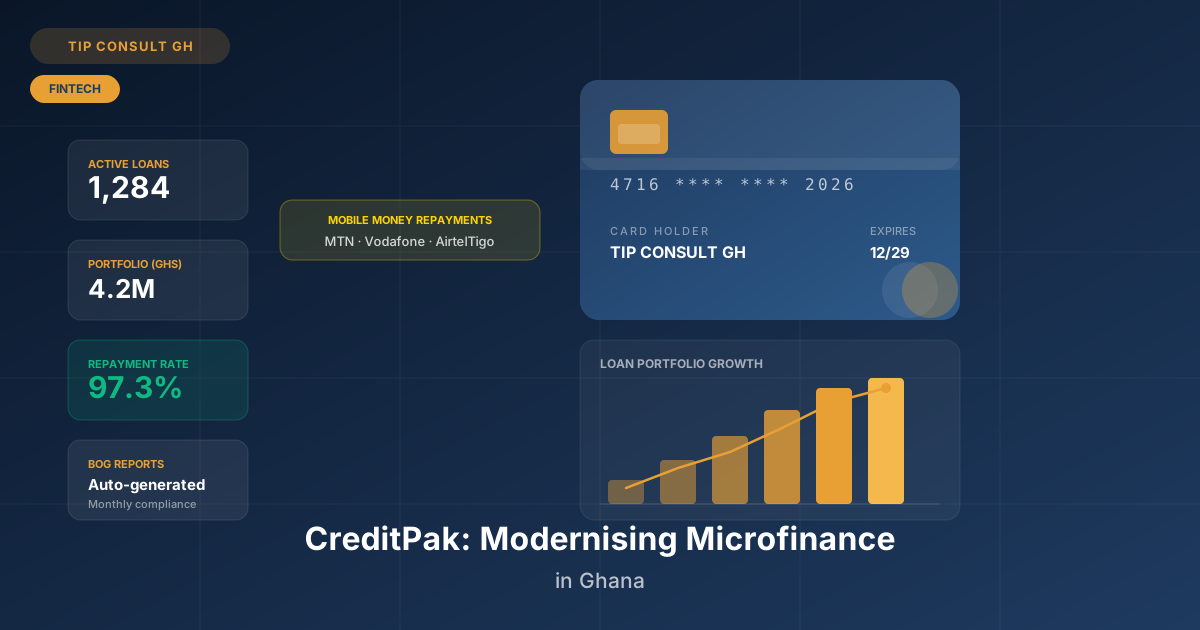
The inflection point came with mobile money. Ghana's mobile money ecosystem is one of the most developed in sub-Saharan Africa. MTN Mobile Money, Telecel Cash, and AirtelTigo Money have collectively brought millions of Ghanaians into a digital payment layer that functions outside the traditional banking system — faster, more accessible, and built for the realities of everyday Ghanaian life.
When a loan repayment can be made via MoMo from a market stall in Kumasi, and reconciled to a borrower's account in real time, the operational logic of microfinance changes completely. The loan officer no longer needs to visit in person to collect cash. The branch accountant no longer needs to manually match payment records at end of day. The friction that made digital management of small loan portfolios impractical — the payment collection problem — has been largely solved.
What that unlocked was an appetite for proper software. Once repayments can flow digitally, it makes sense to manage everything else digitally too: loan origination, approval workflows, arrears tracking, regulatory reporting. The infrastructure problem and the software problem are now being solved together.
Regulation Is Pushing the Same Direction
The Bank of Ghana's regulatory posture toward the microfinance sector has tightened considerably since the financial sector cleanup of 2017 to 2019. Minimum capital requirements were raised. Reporting standards were enforced more strictly. Institutions that could not demonstrate adequate record-keeping and compliance controls lost their licences.
That was painful for many institutions. But it created a clear signal: informal management practices are no longer a viable long-term strategy for any MFI that wants to remain in operation. BOG returns, AML monitoring, credit bureau reporting, IFRS 9 provisioning — these are not optional extras. They are the cost of operating in the sector.
For institutions that were already stretched thin on staff and resources, meeting these requirements manually is genuinely unsustainable. The regulatory pressure is, in effect, a mandate to digitise.
"The institutions that will define Ghana's microfinance sector in ten years are not necessarily the largest ones today — they are the ones investing now in the systems that make compliance effortless and client service fast." — Tip Consult GH
What the Digitisation Wave Looks Like in Practice
The current wave of digitisation in Ghana's microfinance sector is not coming from the top down. The large commercial banks digitised long ago. What is happening now is a ground-up transformation, driven by software built specifically for the MFI context.
- Loan management platforms are replacing spreadsheets — handling origination, approval, disbursement, and collections in a single system that produces regulatory reports automatically
- Mobile money integration is eliminating cash collection — webhook-based reconciliation means repayments post to borrower accounts in real time, reducing both errors and fraud risk
- Cloud hosting is replacing on-premise servers — institutions of any size can now access enterprise-grade software without enterprise-grade infrastructure budgets
- Digital credit scoring is supplementing relationship-based lending — transaction history, repayment patterns, and MoMo data are increasingly used to inform credit decisions
- Automated compliance reporting is removing the month-end scramble — BOG returns that once took days are being generated automatically, with the data the regulator expects already structured correctly
The Opportunity Ahead
Ghana is not alone in this transition. Similar dynamics are playing out across West Africa — in Nigeria, Senegal, Côte d'Ivoire, and across the continent — as mobile money penetration grows and regulators raise their expectations of the microfinance sector. The institutions and the software providers who figure out the Ghanaian context first will have a significant head start as the market regionalises.
The deeper opportunity is financial inclusion. Ghana's credit gap — the distance between the capital that businesses and individuals need and what the formal financial system currently provides — remains significant. Digitised microfinance institutions, operating at lower cost and higher compliance confidence, are better positioned to close that gap than any top-down intervention.
Susu collectors understood something that took the formal banking system decades to accept: access to credit, structured around the rhythms and relationships of real communities, is one of the most powerful economic tools in existence. The digital transformation underway is not replacing that understanding. It is finally giving it the infrastructure it deserved all along.
At Tip Consult GH, we build software for this transition. If your institution is ready to move beyond spreadsheets, get in touch and let's talk about what the right digital infrastructure looks like for your operation.