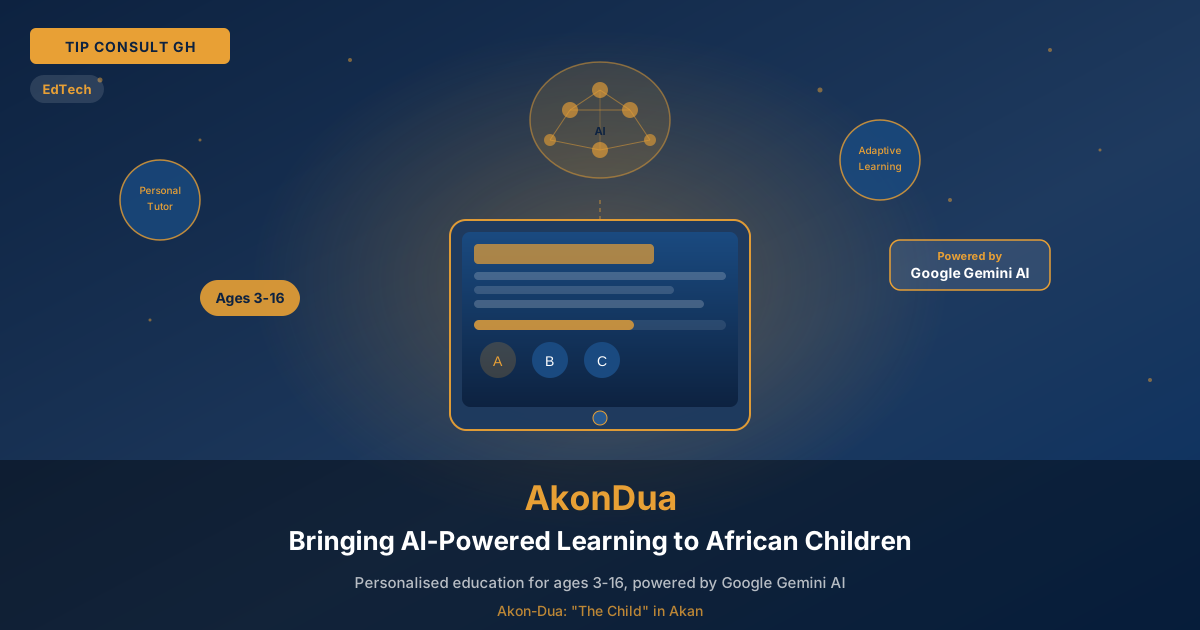
Sub-Saharan Africa has the youngest and fastest-growing population on earth. By 2030, the continent will be home to more than one billion people under the age of 18. What happens to the quality of education those children receive will shape not just Africa's future — it will shape the world's. Artificial intelligence, if it is applied thoughtfully and built for the African context, could be the most significant education intervention in a generation.
Why the Standard EdTech Playbook Has Not Worked
The last decade saw enormous investment in educational technology aimed at the developing world. Tablet programmes. Digital content libraries. Video-based learning platforms. The ambition was real, but the results were largely disappointing — and the reasons are instructive.
Most of what was built assumed infrastructure that does not exist: consistent electricity, reliable broadband, devices with sufficient processing power, and — critically — content that was culturally and curriculary aligned with the schools it was meant to serve. A platform built around the UK national curriculum, translated into French, repurposed for use in Francophone West Africa does not serve the child sitting in that classroom. It serves the assumption that all classrooms are essentially the same.
They are not. The gap between what EdTech promised and what it delivered in Africa is largely a gap between tools built for one context and deployed in another.
What AI Changes About That Equation
The reason artificial intelligence matters for African education is not that it is powerful in the abstract. It is that adaptive, AI-driven learning systems are the first educational technology that can genuinely meet a child where they are — rather than requiring the child to meet the technology where it was designed.
Traditional e-learning is linear. A child watches a video, answers questions, moves to the next video. If they did not understand the first video, the second one compounds the confusion. The system does not know and does not care. AI-driven adaptive learning is different in a fundamental way: it is continuously reading the child's responses, identifying patterns of difficulty, and adjusting what comes next. It is, in effect, a tutor that never gets tired and never has to move on because the rest of the class is ready.
For a continent where the average primary school teacher manages 40 to 60 students with minimal support, the ability to give each child a personalised learning experience — even via a mid-range smartphone — is not a luxury. It is a structural intervention in how education works.
The Infrastructure Problem Is Closer to Solved Than You Think
One of the persistent objections to digital education in Africa has been connectivity. And for good reason — as recently as five years ago, smartphone penetration in many sub-Saharan countries was low, and mobile data was expensive relative to income. That picture has changed substantially, and continues to change.
- Smartphone penetration across sub-Saharan Africa is growing at over 6% annually, with mid-range Android devices now accessible to a much larger share of the population than ever before
- Mobile data costs have fallen significantly across the region as competition between operators has intensified and infrastructure investment has expanded
- Offline-capable apps can now deliver full learning experiences without a live internet connection, syncing progress when connectivity is available — removing the dependency on consistent broadband entirely
- AI model efficiency has improved dramatically — modern AI can run personalisation logic on-device or via lightweight API calls that work on 3G connections, removing the assumption of high-speed internet
The infrastructure barriers that made digital education impractical a decade ago are not gone — but they are lower than the conversation often assumes, and they are falling.
Language and Culture Are Not Edge Cases — They Are the Core Problem
Perhaps the most important and least-discussed challenge in African EdTech is language. Africa is the most linguistically diverse continent on earth, with over 2,000 distinct languages. In Ghana alone, there are more than 80 languages. Most children begin their education in a language that is not their mother tongue — and research consistently shows that early literacy instruction in the mother tongue produces stronger long-term academic outcomes.
For AI-driven learning to work in the African context, it must grapple with this reality. Building content in English only — or even in English and French — leaves out the foundational layer of early childhood learning where mother-tongue instruction matters most. The platforms that will genuinely move the needle are the ones that invest in local language content, not as a feature, but as an architectural priority.
The same logic applies to cultural context. Word problems that reference apples and snow and school buses do not resonate with a child in Tamale or Mombasa. When the examples, names, and scenarios in educational content reflect the child's actual world, engagement increases — and with it, comprehension and retention.
"The technology is no longer the bottleneck. The bottleneck is whether the people building EdTech tools understand enough about African classrooms, African languages, and African children to build something that actually works." — Tip Consult GH
What the Next Five Years Could Look Like
The conditions for a genuine AI-driven EdTech breakthrough in Africa are aligning. Smartphone adoption is accelerating. AI models are becoming cheaper and more efficient to run. A generation of African software developers and entrepreneurs who understand both the technology and the local context is building in this space. And governments across the continent are increasingly looking to technology as a lever for improving educational outcomes at scale.
The platforms that succeed will share certain characteristics: they will be built by people who understand the specific country contexts they serve; they will work on the devices and connectivity that actually exist in those markets; they will take local language and curriculum seriously from the start; and they will measure success by learning outcomes, not download numbers.
Africa's education challenge is real, and it is large. But the tools to address it — built by Africans, for African children, grounded in African realities — are emerging. The next classroom is not a building. It might be a smartphone, running software built right here.
At Tip Consult GH, we are investing in this space. If you are an educator, school operator, or NGO exploring what technology-driven learning could look like for your context, reach out and let's explore it together.